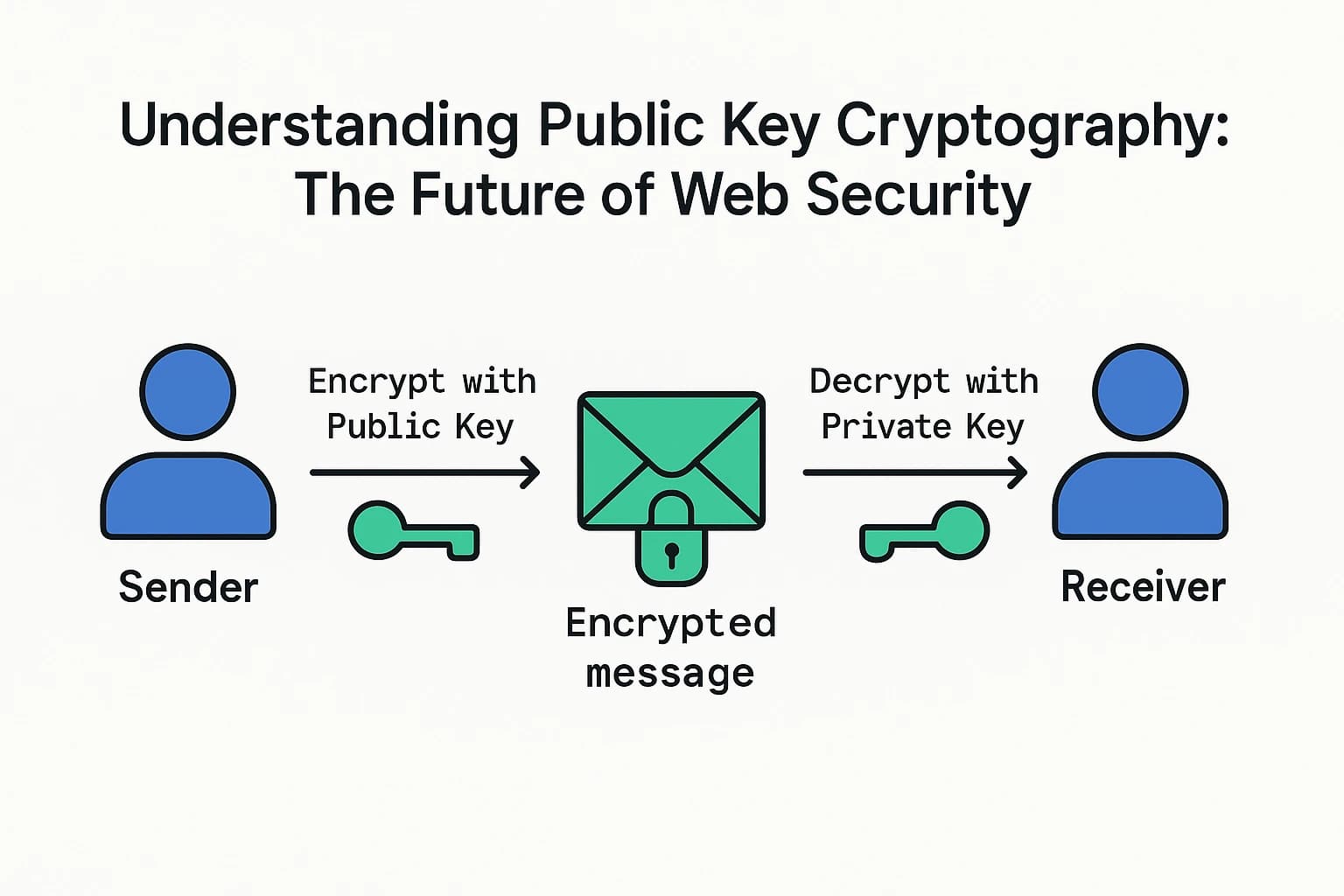
Understanding Public Key Cryptography: The Future of Web Security
If you've heard about "passkeys" replacing passwords or wondered how websites can securely communicate without sharing secret keys, you're encountering the power of public key cryptography. This revolutionary technology is transforming how we think about digital security, yet many people don't understand what makes it so special. Let's explore this fascinating world in plain English.
The Problem with Traditional Security
Imagine you want to send a secret message to a friend across the country. In the old days of cryptography, you'd both need to agree on a secret code beforehand. But how do you safely share that secret code? You can't just email it or say it over the phone – someone might intercept it.
This is exactly the problem that plagued digital security for decades. Every secure communication required both parties to somehow share a secret key first, which created a chicken-and-egg problem: how do you securely share the key needed for secure communication?
Traditional password-based systems face similar challenges:
- Passwords can be stolen in data breaches
- People reuse weak passwords across multiple sites
- Passwords can be guessed or cracked
- Phishing attacks trick users into revealing passwords
Enter Public Key Cryptography: The Game Changer
Public key cryptography solved this fundamental problem with an elegant solution: instead of one shared secret, you use a pair of mathematically related keys. Here's the magic:
- Public Key: You can share this freely with anyone
- Private Key: You keep this secret, never sharing it with anyone
The mathematical relationship between these keys creates two powerful properties:
- Anything encrypted with one key can only be decrypted with the other
- You can create unforgeable digital signatures using your private key
Think of it like a special mailbox: anyone can put mail in (using your public key), but only you have the key to open it and read the contents (your private key).
How It Actually Works: A Simple Example
Let's say Alice wants to send a secure message to Bob:
Step 1: Key Generation
Bob creates his key pair:
- Bob's Public Key: He posts this online, emails it to friends, puts it on his business card
- Bob's Private Key: He keeps this locked away securely
Step 2: Encryption
Alice wants to send Bob a secret message:
- She takes Bob's public key (which she can get from anywhere)
- She encrypts her message using Bob's public key
- She sends the encrypted message
Step 3: Decryption
Bob receives the encrypted message:
- He uses his private key to decrypt it
- Only Bob can read the message because only he has the private key
The Beautiful Part: Alice never needed to share any secrets with Bob beforehand. She used his freely available public key, yet the message remained secure.
Digital Signatures: Proving Who You Are
Public key cryptography also enables digital signatures, which work in reverse:
How Digital Signatures Work
- Alice signs a document using her private key
- Anyone can verify the signature using Alice's public key
- The signature proves the document came from Alice and hasn't been tampered with
This is like having an unforgeable signature that anyone can verify but only you can create.
Real-World Applications You Use Every Day
HTTPS and Secure Websites
When you visit a website with HTTPS (the lock icon in your browser):
- Your browser gets the website's public key from their SSL certificate
- Your browser encrypts your data using the website's public key
- Only the website can decrypt your data using their private key
- The website's certificate is digitally signed by a trusted authority
This happens automatically every time you visit a secure website, online banking, or shop online.
Email Security
Modern email security (like Gmail's confidential mode or ProtonMail) uses public key cryptography:
- Your emails are encrypted with the recipient's public key
- Only they can decrypt them with their private key
- No one else – not even the email provider – can read your messages
Code Signing
When you download software, it's often digitally signed:
- The software company signs their programs with their private key
- Your computer verifies the signature using the company's public key
- This proves the software is genuine and hasn't been tampered with
The Passkey Revolution
Passkeys represent the newest evolution of public key cryptography, designed to replace passwords entirely.
How Passkeys Work
- You create an account on a website
- Your device generates a key pair specifically for that website
- The website stores your public key
- Your private key never leaves your device
When You Log In
- The website sends a challenge (like "prove you're you")
- Your device signs the challenge with your private key
- The website verifies the signature using your stored public key
- You're logged in – no password needed!
Why Passkeys Are Revolutionary
Phishing Becomes Impossible: Since your private key never leaves your device and each key pair is unique to each website, even if you're tricked into visiting a fake website, your passkey won't work there.
No Passwords to Steal: Websites only store your public key, which is useless to attackers. Even if the website is breached, your account remains secure.
Convenient and Fast: No passwords to remember, type, or reset. Just use your fingerprint, face recognition, or device PIN.
Works Across Devices: Passkeys can sync securely across your devices through your platform's ecosystem (Apple, Google, Microsoft).
What Makes This Technology So Powerful
Mathematical Foundation
The security comes from complex mathematical problems that are easy to solve in one direction but nearly impossible to reverse. Even with the most powerful computers, it would take longer than the age of the universe to crack properly implemented public key cryptography.
No Shared Secrets
Unlike traditional systems where both parties need to know the same secret, public key cryptography eliminates this vulnerability. There's no secret to intercept or steal during the initial setup.
Non-Repudiation
Digital signatures provide non-repudiation – you can't deny that you signed something. This is crucial for legal documents, contracts, and financial transactions.
Forward Secrecy
Modern implementations use techniques like ephemeral keys, ensuring that even if a private key is compromised, past communications remain secure.
The Network Effect
Public key cryptography becomes more valuable as more people use it:
- More websites support passkeys → easier to go passwordless
- More email providers support encryption → private communication becomes the norm
- More software is digitally signed → safer computing for everyone
Common Misconceptions
"It's Too Complex"
While the mathematics is complex, using public key cryptography is often simpler than traditional methods. Passkeys are easier than passwords, and HTTPS works automatically.
"It's Slow"
Modern hardware and optimized algorithms make public key operations fast enough for real-time use. Your phone can generate and verify signatures in milliseconds.
"It's Not Mature"
Public key cryptography has been around since the 1970s and secures trillions of dollars in transactions daily. It's one of the most battle-tested technologies in computing.
The Future is Bright
Quantum Resistance
Researchers are developing quantum-resistant algorithms to protect against future quantum computers, ensuring long-term security.
Wider Adoption
Major tech companies are pushing for passwordless authentication, with passkeys supported by Apple, Google, Microsoft, and others.
Simplified User Experience
New standards and protocols are making strong cryptography invisible to users while maintaining security.
Why This Matters to You
Whether you realize it or not, public key cryptography already protects much of your digital life:
- Your online banking is secured by it
- Your messaging apps use it for encryption
- Your software updates are verified with it
- Your email can be encrypted with it
As passkeys become more common, you'll enjoy:
- No more password resets
- No more password managers (though they're still useful for legacy sites)
- No more phishing vulnerabilities
- Faster, more secure logins
Getting Started
You don't need to understand the mathematics to benefit from public key cryptography:
- Use websites that support passkeys when available
- Enable two-factor authentication (which often uses public key cryptography)
- Look for the lock icon when browsing websites
- Keep your devices updated to get the latest security improvements
Conclusion
Public key cryptography represents one of the most important innovations in computer science. It solved fundamental problems that seemed impossible to overcome and continues to evolve to meet new challenges.
The transition from passwords to passkeys isn't just a minor improvement – it's a fundamental shift toward a more secure, private, and user-friendly internet. As this technology becomes more widespread, we're moving toward a future where strong security is the default, not the exception.
The best part? You don't need to understand the complex mathematics to benefit from this revolutionary technology. Just like you don't need to understand how your car's engine works to drive safely, you can enjoy the benefits of public key cryptography simply by using modern, secure services.
The future of digital security is here, and it's more accessible than ever before.
As this technology continues to evolve, staying informed about new developments in digital security will help you make better choices about protecting your digital life.